

2025 Sejong International Judicial Conference
- About the Conference
- Program
- King Sejong the Great and the Rule of Law
About the Conference
The Supreme Court of Korea hosted the Sejong International Judicial Conference in honor of King Sejong the Great's leadership and significant achievements in the field of law. King Sejong is renowned for creating the Korean alphabet, Hangeul, in 1443. During his 32-year reign, he implemented comprehensive legal reforms, enhancing access to justice and strengthening the rule of law. The conference celebrated King Sejong’s legal legacy by bringing together chief justices, judges, and legal scholars from around the world.
Date: September 22 -23, 2025
Venue: Shilla Hotel, Seoul, South Korea
Main Topics
- The Great Legal Legacy of Sejong: A Commemorative Session
- The Rule of Law: Navigating Towards Sustainable Justice
- Justice for All: Pathways to Equal Access
- Justice in the Age of AI: When Law Meets Technology
- The Role of Courts in Safeguarding Technology and Innovation
Participants
- A total of 511 Chief Justices, judges, legal professionals, and representatives from the World Bank and OECD took part in the event.
Program
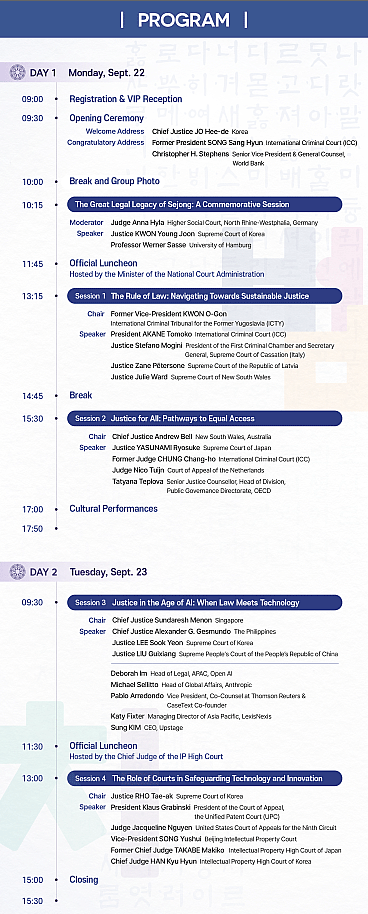
King Sejong the Great and the Rule of Law
1. Who was King Sejong?
King Sejong the Great (1397-1450) was one of the most outstanding Korean kings of the Joseon dynasty. His 32-year reign (1418-1450) as the fourth king flourished with exceptional artistic, cultural, political and scientific achievements, thus effectively reflecting his ruling philosophy of creating a "livable and upright nation."
2. Communicating with People Using Hangeul
The Korean alphabet, Hangeul(한글), was created in the 25th year (1443) of King Sejong's reign and promulgated in its 28th year (1446). The creator, the reasons for its creation, and its principles are well written in the Hunminjeongeum Haeryebon, a manual published during King Sejong's reign.
King Sejong personally presided over cases as the final justice for crimes punishable by severe penalties. He sympathized with the plight of the poor, illiterate people who were being tried for crimes and could not express their grievances in writing to a judge.
King Sejong hoped that all people should be able to easily learn a written form of expression. Consequently, he created a phonetic writing system with 28 simple characters based on the sky, earth, humans and the shape of articulatory organs.
In the Hunminjeongeum Haeryebon preamble, King Sejong first described the history of Hangeul's creation as follows: "I pitied the people suffering from conveying their own ideas due to the discrepancy between the spoken and written language of this country, so I created 28 new characters. It is my wish that all the people may easily learn these letters and freely use them in their daily lives." Then the King's subject, Jeong In Ji, added, "The use of Hangeul will make it possible for the judge to understand the exact situation by carefully reading the details of a trial in an understandable Korean language."
King Sejong's creation of Hangeul was deeply rooted in the spirit of compassion and closely tied to the judicial process. Hangeul enabled people to describe their circumstances and allowed the accused to explain their inner stories, thereby preventing unfair punishment.
3. King Sejong's Principle of the Rule of Law
King Sejong implemented extensive reforms to the legal system, effectively addressing the judicial shortcomings of the Joseon dynasty. During his reign, a unified legal code was developed to lay the groundwork for a fairer legal system in many areas. Recognizing that some people were committing crimes out of ignorance of the law, he promptly promulgated new laws to ensure the people's understanding. King Sejong also upheld the rule of law in taxation, ensuring that taxes were levied and collected according to the tax laws. After conducting a nationwide survey, tax laws were adjusted to reflect the crop prospects and fertility of the land.
Regarding the resolution of disputes, King Sejong defined a good system of judgment as one in which the dead held no grudges and the living have no complaints. He endeavored to strictly enforce the law after publicizing the legal norms. The principle of criminal justice was established through repeated refusal to punish people for crimes committed before the law was enacted and implemented. He also limited the use of torture in the investigative process and guaranteed fair trials based on concrete evidence when torture witch trials were widespread in Europe.
King Sejong closely identified the wrongly accused and went to great lengths to exonerate them, as demonstrated when he acquitted a serf accused of murder after conducting three retrials. In addition, he emphasized the importance of expeditious trial to prevent delays in delivery of judgements.
During King Sejong’s reign, great efforts were made to protect the socially disadvantaged. Several measures were taken to improve the living conditions of prisoners. In addition, King Sejong implemented remarkable protections for the serf class despite their low social status. Under his reign, serf mothers were granted 100 days of maternity leave, and serf fathers were granted 30 days. This practice parallels the modern maternity leave policy in many countries today.
4. Continuing King Sejong's Philosophy of the Rule of Law Today
More than 580 years have passed since the creation of Hangeul. Yet, King Sejong's spirit of compassion and the rule of law continues in the Korean judiciary as we strive to ensure the people's fundamental rights and the protection of minorities.
The Korean judiciary is systematically studying King Sejong's ideas and achievements regarding the judicial system, reinterpreting his philosophy in the modern context, and seeking ways to improve our judicial system. We are committed to sharing these insights and collaborating with other countries to further uphold the rule of law and promote justice in the international community.