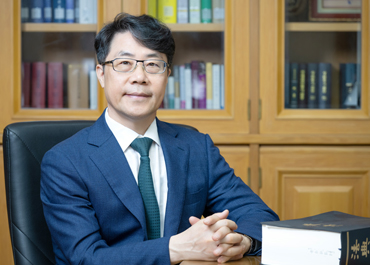

KIM Seong Soo
The Honorable KIM Seong Soo was born in Hampyeong, Jeollanam-do, on August 26, 1968. Justice Kim earned an LL.B. from Hanyang University, College of Law and passed the 34th National Judicial Examination in 1992. He subsequently served as a public-service advocate (1st class), where he gained practical experience in state litigation. He began his judicial career as a judge at the Gwangju District Court in 1998. Justice Kim has served as a judge at a number of courts and held various positions in the organizations affiliated with the Supreme Court, including the Haenam Branch Court of the Gwangju District Court, the Ansan Branch Court of the Suwon District Court, the National Court Administration, the Seoul High Court, the Jeju District Court, the Daejeon High Court Cheongju Chamber (concurrently serving as Chief Presiding Judge of Cheongju District Court), the Suwon High Court, and the Judicial Research and Training Institute. While serving as a Presiding Judge of the Seoul High Court, he was appointed a Justice of the Supreme Court on September 18, 2026.
Over the course of his 28-year career as a judge, Justice Kim has handled a wide range of civil, criminal, and administrative cases. Always being mindful that the administration of justice rests fundamentally on sincerity and careful deliberation, he has sought to ensure both procedural satisfaction for the parties and the discovery of substantive truth by listening attentively to the parties and conducting proceedings with care, even in cases that might appear relatively minor. In recognition of such approach to adjudication, he was selected as an outstanding judge in the judicial evaluations conducted by the Chungbuk Bar Association in both 2018 and 2019. He has also earned the trust and respect of his colleagues for his warm and considerate character.
Having served at a number of courts with jurisdiction over rural, fishing, and island communities, he gained insight into diverse lives and circumstances of the people, which led to his deeper understanding of the lives of the litigants behind each case. He has sought to safeguard constitutionally protected freedom and rights of the people and to protect the socially vulnerable and minorities. Among his notable decisions are a decision that opened a path to the restoration of property rights for farmers whose distributed farmland had been taken by the State, by granting a petition for a retrial against a judgment rendered in a retrial proceeding; a decision holding that acts by senior officials of the National Intelligence Service in breach of their duty of political neutrality could also constitute violations of the Public Official Election Act, and imposing severe punishment accordingly; a decision recognizing that an internet portal operator bears responsibilities comparable to those of a media organization; and a decision revoking a local government's disposition denying permission to install a waste disposal facility, an action taken with the upcoming election in mind.
Justice Kim has authored case commentaries in the fields of labor law and state compensation law, including “A Study on Atypical Severance Pay Systems through Cases” (2003) and “Limitations on State Liability for Damages with Respect to Special-Status Public Officials” (1998). His service in the Judicial Ethics and Inspection Office of the National Court Administration in 2006 prompted him to reflect deeply on the ideal qualities the public expects of a judge, and he contributed to establishing sound judicial ethics by serving as the Judiciary’s coordinator in launching the Legal Ethics and Professional Conduct Council. He also endeavored to improve adjudication capacity of individual judges and capacity building for members of the judiciary. From 2023 to 2025, as Chief Professor of the Judicial Research and Training Institute, he planned and administered a wide range of programs, including a program for newly appointed judges, professional development training, and judicial practice training. He expanded professional training for law clerks, military judges, and judicial assistant officers, as well as international cooperation programs, and led efforts to publish various practical manuals.